https://seoulistic.com/korean-culture/20-cultural-mistakes-to-avoid-in-korea/
1.Sitting in elderly seats in subways
You are in the subway and you see all the seats being taken apart from the ones at the far end which are reserved for the elderly or women who are pregnant. Even if they are unoccupied I would suggest you leave them empty unless you want a big scolding from an elderly. I remember in a subway once a young woman was sitting on the elderly seats because there were no more seats available. Soon enough an old man comes in and even though there were plenty of other elderly seats available she got scolded (very badly) and was forced to stand up. Trust me, you wouldn’t want to piss off an ahjumma or ahjussi in Korea. It’s not a pleasant experience so do your best to avoid it…

Source: My Sassy Girl
2. Sticking your chopsticks in your rice
Especially when eating with other people, avoid sticking your chopsticks into your rice. In traditional Asian culture (not just Korean), people usually stick incense sticks upright in a bowl of sand at funerals for ancestor worship and it is believed to be food for the spirits. Sticking your chopsticks in a bowl of rice reminds people of that. Are you trying to say your friends at the table are already dead? Of course this is not a fact, more of a superstition. But avoid doing it in case you get a big scolding or uncomfortable looks from your friends and family.
3. Refusing a soju shot with an ahjussi/ahjumma

Source: WordPress
So you are in a restaurant with someone much older than you and he or she offers you a shot of Soju or Korean beer with him or her. In Korea this is not a gesture of trying to get you totally wasted, but it’s a sort ritual of respect and friendship. If you do not drink alcohol whatsoever, replace it with water or any soft drink. Rather than the beverage itself, the ritual is seen as most important. Refusing the shot however can be very offending to Koreans as it may look as though you don’t want to be their friend! =(
4. Facing an elder whilst doing a shot
Once accepting the ritual you will have to drink whatever is in your shot glass whether it may be Soju, beer, water etc. When drinking with a senior or an elder make sure you turn your head or back away from anyone higher rank than you as a sign of respect. This ritual is very common when dining out with your work colleagues. Anyone older than you or higher up the ladder should be treated differentially, and a gesture to express that is by turning your head or back away from them.
You’ve done it! Now on to the next 20 work colleagues…
For a more detailed explanation of Korea’s drinking culture, click here!
5. Writing names in red ink
You are writing a birthday card, and the nearest pen you can reach is the red ink pen. The receiving person opens up the card and instead of seeing a happy reaction, the birthday gal (if Korean) will most probably be in shock or offended. Why? There are many superstitions here in Korea, and one of them is writing a person’s name in red ink. By doing that it means they will die soon or you want them to die. This is because a long time ago the names of the deceased were written in red on registers, gravestones and plaques to ward off evil spirits. You can try this out when you write a letter to your ex-lover 😉
6. Blowing your nose at the dinner table
Let’s be honest. Seeing someone at the dinner table blowing their nose is not a pleasant sight right? Especially when they catch a bad cold and it makes a weird gooey noise, it’s enough to put you off from your own food. It also displays poor hygiene as after blowing your nose your hands will be full of germs! When eating with people, it’s best to excuse yourself to the bathroom so that you can handle your business and then wash your hands straight after. Of course, maybe amongst close friends I’m sure they won’t mind.
7. Receiving with one hand
In Korea this is seen as very important in terms of receiving and giving. Using one hand (especially if it’s with your left hand) is considered to be rude so try and get in a habit of always using both hands to give or receive things. There was an incident with Bill Gates when he shook Korea’s President, Park Geun Hye’s hand with one hand (bad idea) while his left hand was inside his pocket (terrible idea). Anyways it caused him to be heavily criticized by the people and the media and is now being labelled as rude and disrespectful. The ‘two hands’ culture is only important between the interaction of two people for example giving someone a gift, or even pouring someone some water.
8. Wearing shoes at someone’s home
For obvious reasons wearing shoes inside someone’s home is very unhygienic. Koreans spend a lot of time cleaning their floors because the Korean lifestyle is usually centred around the floor. Usually dining tables are very low to the ground as traditionally dinner is eaten by sitting on the floor. Even today, most people sleep on the floor, so it is important to keep it hygienic and clean. In Korean houses or apartments the entrance is usually lower than the rest of the home. This design allows for all dirty, wet things to be left in the entrance so that the house stays clean.
9. Eating first at the dinner table
Do you have times where you are so hungry the only thing you can think of is sitting down and start munching down your food? In Korea, unless you are eating with your closest friends, you should not even pick up your chopsticks unless the oldest person at the table picks up his or hers. The oldest person at the tables must eat first and then you are able to start eating. Respect to elders has always been a very strict and important tradition in Korea. Therefore, if you are extremely hungry, I’m afraid you’re going to have to be a little patient until the oldest person lift up their chopsticks.
10. Pouring water for yourself only whilst eating with your friends or family
Yes, that’s right. Pouring water for yourself only will look as though you only care about yourself and think less of others. Before pouring yourself a drink, check everyone’s cups and if they need refilling pour water for them first. Remember to pour water for the oldest one at the table first before others. If you do that, the Koreans will be very impressed and you would make a very good impression of yourself. If you get enough brownie points from the Koreans I’m sure they would want to take you out for dinner next time. Their treat of course =D
11. Not setting up utensils
From a very young age, Korean parents teach and discipline their children dinner etiquettes and traditional customs. This includes them preparing the table before dinner which involves setting up chopsticks, spoons, bowls, side dishes, napkins, pouring water in every cup etc. As foreigners, Koreans don’t really expect you to already know all of the traditional customs, but this is again another chance to make a good impression as well as to become more culturally enriched.
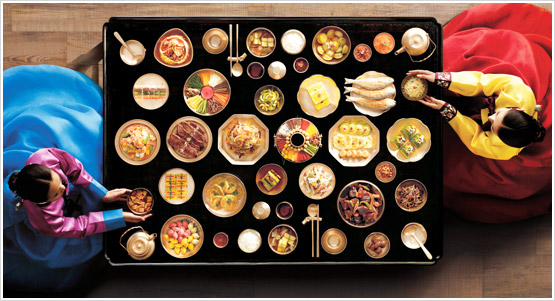
Source: visitkorea.or.kr
12. Getting up and leaving the table before elders do
If you finish your food early I’m afraid you might have to wait until everybody finishes before leaving the table. If you finish early and wait you might give others the impression you are waiting for them to finish, hence they will eat faster. To avoid this misunderstanding try to keep at a similar pace along with other people so that you don’t finish your meal too early. However if you have kept at a steady pace and finished early, place your chopsticks and spoon on the table and wait until the elder gives you permission to leave the table.
13. Touching an elder or someone at a higher rank than you on the head or shoulder
Especially on the head or shoulders! When Koreans touch someone’s head or shoulders, it is usually to a child or someone younger than them. If you touch a senior on the head or shoulder, it can be very down-grading, impolite and disrespectful. It is as though you are treating them like a child!
For now, I guess you should keep your touchy-feely hands to yourself. Even between friends, touching the opposite sex can be quite an intimate action. Therefore to avoid any misunderstanding avoid free touching in general unless you have the hots for someone. 😉
14. Not sharing

Source: blogspot
So one afternoon in the office you feel a little peckish hence you go out and buy yourself some potato chips to snack on. You are then busy enjoying the snacks all by yourself in the office and before you know it all your colleagues are looking at you frowning or staring at your potato chips hoping to have a nibble too. This is because in Korea it is a ‘sharing’ culture. It is a special concept in which Koreans call ‘jeong’ and it is a special kind of love between the people and society. If you don’t share you will be seen as a little greedy and have little or no ‘jeong’. To find out more about this special kind of ‘love’ in Korea check out this special article and video on ‘jeong’.
15. Talking loudly on the bus or subway
Any loud noise anywhere can be a little disturbing, and what more disturbing noise can you get than people talking loudly on public transport? You may think people will just try and ignore it, but Koreans will not hesitate and tell you to actually ‘be quiet’, especially the tired ones who are trying to catch up on sleep on the way to work. In some extreme cases it is possible to get scolded even in a restaurant for speaking too loudly. It is not to say you should only whisper when talking to your friends. Just watch out for the volume you’re making when you are with your friends….or experience the wrath of a tired ahjumma or ahjussi 😉
16. Turning up to someone’s apartment empty handed
Koreans really like their privacy so it is not common for people to invite people over to their homes as often as some people do in other parts of the world. So if a Korean family invites you over to their apartment for the first time, that’s a pretty big deal and it’s awesome for them to do so. And don’t you want to be awesome back? Giving a gift shows that you have manners in Korea and it also says “thanks for inviting me over” or “sorry for intruding your private space T_T”. No clue as to what gifts to get for Korean families? Find out more here!
17. Not paying for round 2
Usually when you eat dinner with an older person he or she will generally buy you the whole meal. Why? It’s just a Korean custom. Your older friend might be working so they will have their own money to treat you. In order to return that kind gesture you can either pay for the next meal or pay for round 2! Round 2 can vary from getting some dessert or to just simply going to a café for some coffee. What looks really bad is when your friend pays for the dinner and you still try to calculate to split the bill for round 2!
To know more about how ‘rounds’ work click here!
18. Clothing which expose your shoulders (girls only)
Although society is slowly changing in Korea, it still remains quite a conservative country. Hence what you wear can give off certain impressions of yourself. In Korean society girls who wear clothing which expose their shoulder blades are considered too ‘sexual’ or ‘too revealing, more so than girls who wear super short mini-skirts. However as mentioned before, the society is changing and you can see women today wearing clothes which show a little bit of shoulder, but the majority today still covers them up….but super mini-skirts and hot pants are still completely acceptable. =/
19. Showing the bottom of your shoe or foot
Some of you might already think “when and why on Earth would I show someone the bottom of my foot?!” Usually guys like to cross their legs the way in which one foot rests on the other knee. This then shows the bottom of your shoe! Especially in a working environment or when talking to the elders, showing the bottom of your shoe is a sign of disrespect! Ensure to keep both legs on the ground or you can cross your legs in a way that doesn’t show the bottom of your shoe. Let’s just hope it doesn’t hurt too much when doing that (if you know what I mean guys 😉 )
20. Leaving tips

Source: blogspot
One of my favourite things about Korea is that there is no need nor are you expected to give tips for any services. With the exception of some tourist hotels, 10% service charge may be already added to your bill. You are not expected to tip in taxis too however it is possible to tell the driver to keep the change (usually anything less than 1000 won). Be careful however as sometimes tipping can be considered an insult, so it’s best not tip overall than risking offense to someone right? 😉
Are there any rules or traditional customs that foreigners should be aware of in your country? Let us know by commenting below ^^